Olivier ‘Tavu’ Ente – Jazz minute
Intro and photo by Charles Paratte – 🇫🇷 version plus bas
By pure chance, I found myself on a Paris street, witnessing Tavu in the middle of installing an ephemeral artwork right onto a Métro map—the very piece that this article is about. I’ve always appreciated Tavu’s work, and I always try to get my hands on a copy of his publications. But whenever I see him, I’ll admit I’m more used to our usual skate-nerd talk, which is always a blast. This time, instead of asking him who did a backside flip down the stairs of the Lille DDE or which bank is skateable behind Saint-Sulpice church, I let him do the talking about this temporary piece—and honestly, he’s great at that too.
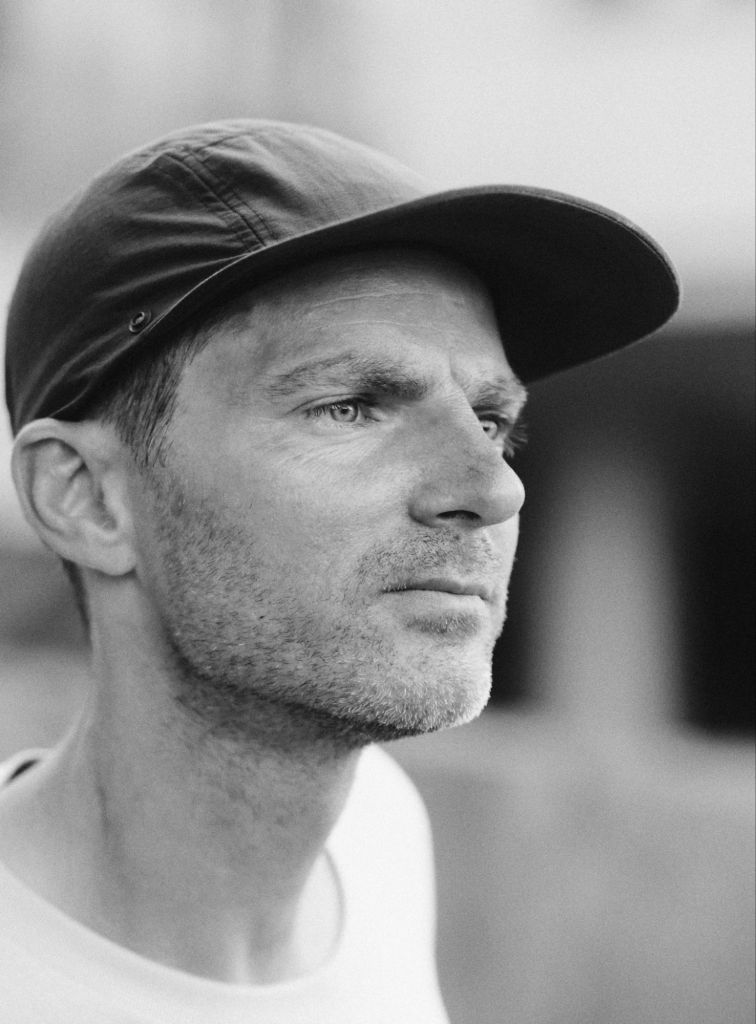
“When I first moved to Paris, I spent a lot of time cruising through different neighborhoods, and I’d often skate through Strasbourg-Saint-Denis on my way down from Pigalle, where I live. It’s a lively area (stretching between the 2nd, 3rd, and 10th arrondissements), with Rue du Faubourg Saint-Denis packed with bars and restaurants. I often took a detour through there because of Boulinier (a secondhand bookstore); they always had these collector-type maps—vintage and unique ones—for fifty cents or a euro. So, I’d constantly stop by to check it out, hunting for gems.
For those who are already familiar with my drawings, I always sketch a portrait onto a map, with a more or less specific connection between the two elements. And usually, in the back of my mind, there’s a nod to a specific creation by the artist I’m depicting.
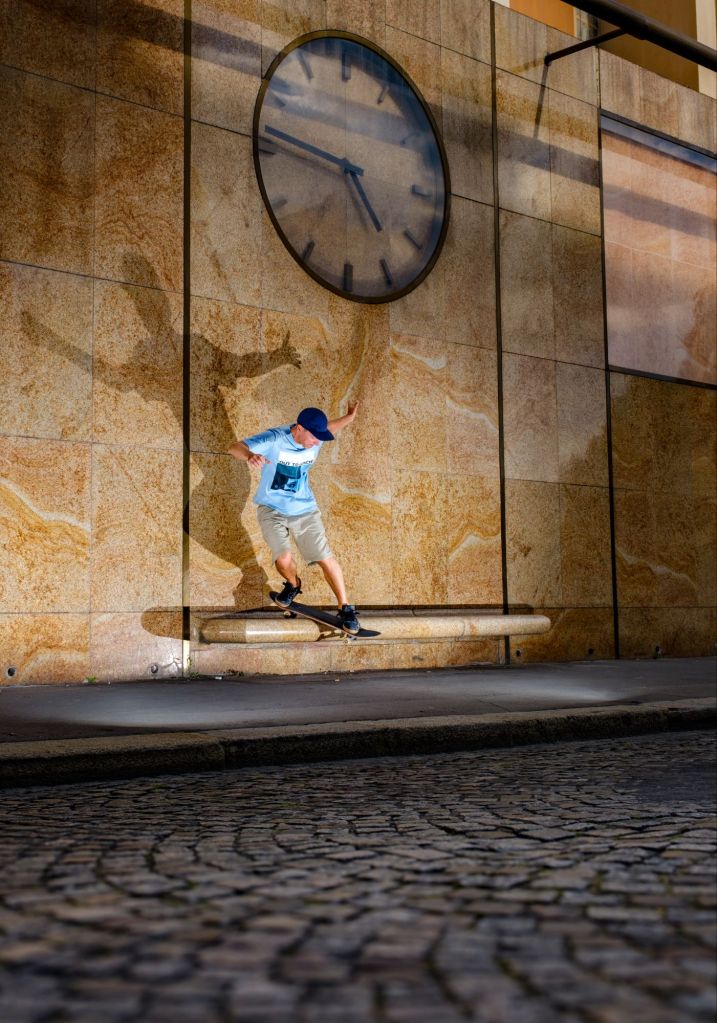
When I first started doing these pieces, skateboarding and drawing shared a few common threads: using different maps, and the idea that everyone sees the world through their own filters, having a unique representation of reality. Yet, the two activities were completely separate. Complementary, nonetheless: during the hours I spent drawing, I was sitting at my desk, indoors, focused, in a static process; whereas to go skate, I was in motion, outdoors… With these street projects, the two practices came closer together in some ways.
As I mentioned earlier, there is always a genuine connection between the portrait and the map I choose. And at some point, I wanted to get even more specific with the location by using maps that I find directly in the street, as close as possible to the story I want to highlight.
I wasn’t quite sure how to go about it at first, but I quickly started using plexiglass sheets to play with transparency between the portrait and the map in the background. I use oil-based ink markers so it holds onto the plastic.
But before any of that, you have to do a bit of scouting. That’s where, in a sense, skating and drawing meet: for every project like this, I go cruise around the neighborhood in question to spot the different maps in the street, see what’s possible, measure the size, envision the final photo, and so on. It’s a lot like spot hunting.
Of course, once I have all the elements in mind, I work on the plexiglass at home. The technique makes it a bit different too—the formats are often much larger than the drawings I usually do on paper maps, and it’s stiffer too, so I find myself working on my feet with the sheet placed on an easel.
But once it’s finished, going to put it up in the right spot and seeing the result is pretty cool. With the transparency effect, it’s actually quite hard to tell when you’ve hit the right shade; on a white background it looks perfect, but with a map behind it, the drawing needs to be a bit darker. I got caught off guard by that at the beginning, haha. There can also be interactions with passersby, which is always interesting.
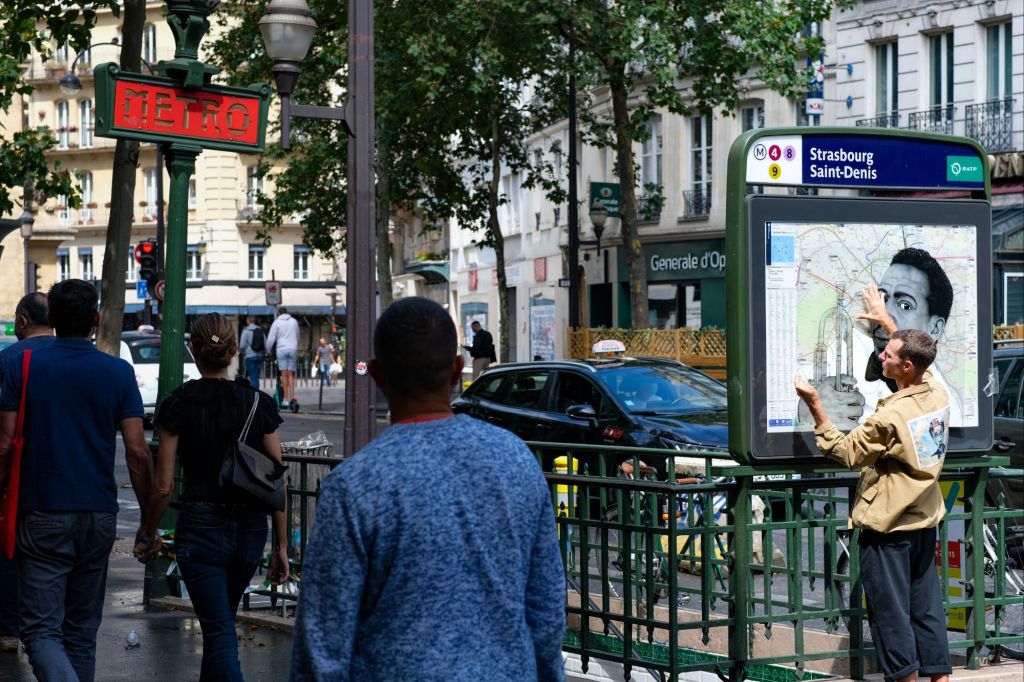
The day I went to put it up, my friend Benjamin Deberdt was the one who called the timing. I had asked him to come take a few lifestyle shots during the installation, and he had some free time that Sunday morning. It was perfect. Walking down from Pigalle, where I live, all the way to Strasbourg-Saint-Denis, I kept passing a procession of vintage cars going the opposite direction—each one more improbable than the last. By the time I reached the metro station, it was almost over, but I set everything up quickly before Benjamin arrived, and I took this photo with a few vintage cars on the side. It’s not always easy to get an interesting shot, but there, it added something truly anachronistic. It was the perfect moment!
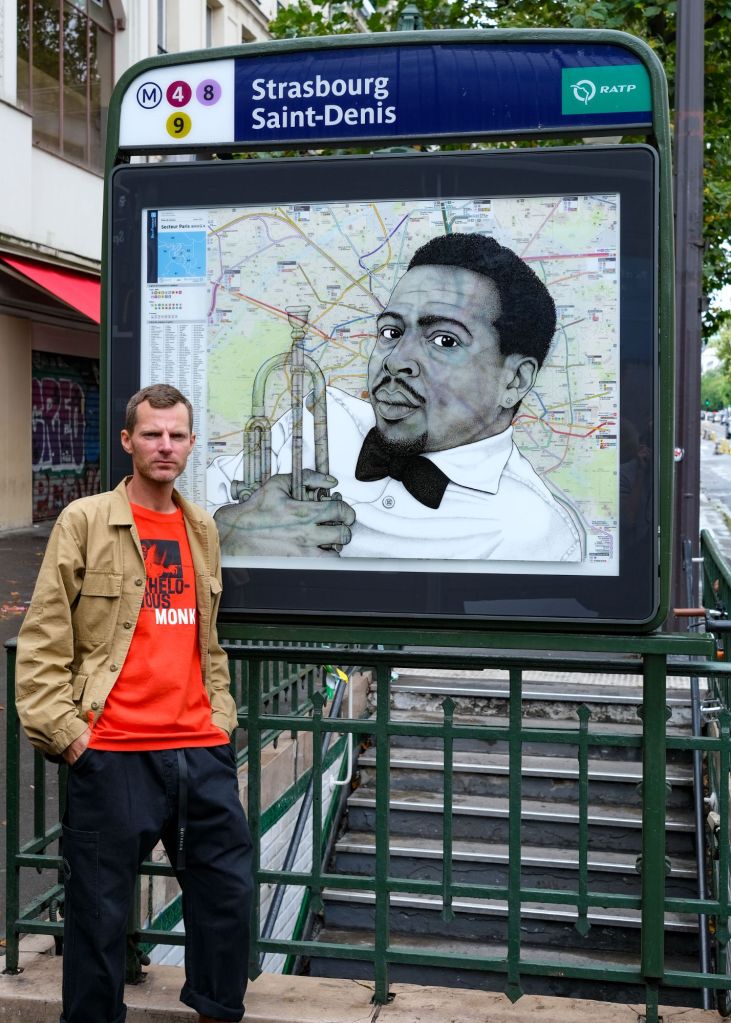
I don’t leave the artwork there afterward: my goal is to photograph it, then I take it back so I can showcase it later in exhibitions, etc.
I had known Roy Hargrove for a while and listened to him from time to time, but by chance, I stumbled upon a DVD released in 2010: a live concert recorded on July 24 and 25, 2007, at the New Morning (a historic jazz club that opened in 1981, located in this very neighborhood).
In this live recording, you see Roy Hargrove playing the track ‘Strasbourg St Denis’ for the first time, saying in the intro: ‘This is a tune that I wrote about two years ago, while I was staying in a hotel across the street… Strasbourg-Saint-Denis, it’s a fun place.’
The track was released in 2008 on the album EARFOOD. The cover photo was taken on stage at the New Morning the night of that concert. He had a deep connection with that venue: he performed there no less than 35 times throughout his career. That’s something I really like too.
It was all these elements that made me want to do this project. With the song title matching the neighborhood name, it was just perfect!”
Follow Tavu on Instagram there @tavu_ensemble
Watch the documentary he directed about the history of the music scene in his hometown, Lille: ’93 Still’.
Un peu par hasard, je me suis retrouvé dans une rue de Paris témoin de Tavu en pleine installation d’une œuvre éphémère sur le plan du Métro, œuvre qui fera l’objet de cet article. J’ai toujours apprécié le travail de Tavu et j’essaye toujours de mettre la main sur un exemplaire des ses publications. Mais lorsque que je le vois, je reconnais que je suis plus habitué aux conversations de skate-nerd, et c’est toujours très agréable. Cette fois, plutôt que de lui demander qui avait fait backside flip sur les marches de la DDE de Lille ou quel plan incliné est exploitable derrière l’église Saint Sulpice, je lui ai laissé la parole sur cette œuvre temporaire, et ça il le fait très bien aussi.
“En arrivant à Paris, j’ai passé beaucoup de temps à cruiser dans différents quartiers, et je passais souvent par Strasbourg-Saint-Denis en descendant de Pigalle, là où j’habite. C’est un quartier animé (situé entre le 2ᵉ, 3ᵉ et 10ᵉ arrondissement), avec la rue du Faubourg Saint-Denis pleine de bars et de restos. Je faisais souvent un détour par là aussi parce qu’il y a un Boulinier (librairie seconde main), et il y avait tout le temps des cartes un peu collector, en tout cas anciennes et différentes, pour cinquante centimes ou un euro. Donc je passais tout le temps jeter un œil par là, à la recherche de pépites.
Pour ceux qui connaissent déjà un peu mes dessins, à chaque fois, je dessine un portrait sur une carte, avec un lien plus ou moins précis entre les deux éléments. Et j’ai souvent en tête, derrière ça, une création que l’artiste représenté a faite.
Quand j’ai commencé à faire ces œuvres, la pratique du skate et celle du dessin partageaient quelques idées communes : l’utilisation de cartes différentes, l’idée que chacun voit le monde à travers ses propres filtres et a une représentation unique de la réalité.
Mais les deux activités étaient vraiment séparées. Complémentaires malgré tout : pendant les heures que je passais à dessiner, j’étais assis à mon bureau, à l’intérieur, concentré, dans un processus statique ; alors que pour aller skater, j’étais en mouvement, à l’extérieur…
Avec ces projets dans la rue, les deux pratiques se sont, à certains endroits, rapprochées.
Comme je le disais plus tôt, à chaque fois, il y a une vraie connexion entre le portrait et la carte que je choisis. Et à un moment donné, j’ai voulu être encore plus précis dans l’emplacement, en utilisant des cartes que je trouve directement dans la rue, au plus proche de l’histoire que je veux mettre en avant.
Je ne savais pas trop comment faire au début, mais rapidement, j’ai utilisé des plaques de plexi pour pouvoir jouer sur la transparence entre le portrait et la carte en fond.
J’utilise des marqueurs à encre à l’huile pour que ça tienne sur le plastique.
Mais avant ça, il faut aussi faire un peu de repérage. C’est là où, dans un sens, le skate et le dessin se rejoignent : pour chaque projet de ce genre, je vais cruiser dans le quartier en question pour repérer les différentes cartes dans la rue, voir ce qui est possible, mesurer la taille, imaginer la photo finale, etc.
Un peu comme une recherche de spot.
Bien sûr, une fois que j’ai tous les éléments en tête, je travaille chez moi sur le plexi. La technique fait que diffère un peu aussi, souvent les formats sont beaucoup plus grand que les dessins que je fais d’habitude sur les cartes papier et c’est plus rigide aussi donc je me retrouve à travailler debout avec la plaque posée sur un chevalet.
Mais une fois terminé, aller le poser au bon endroit et voir le résultat, c’est assez cool, avec l’effet de transparence, c’est assez dur de se rendre compte quand la bonne nuance est atteinte, sur un fond blanc ça paraît nickel mais avec une carte derrière il faut que le dessin soit un peu plus foncé, je me suis fait avoir au début haha.
Il peut y avoir une interaction avec les passants aussi, c’est toujours intéressant.


