SKATEISTAN founder – Oliver Percovich interview

Interview and intro by Charles Paratte
While visiting the Connect Festival in Bordeaux, I walked past the Skateistan booth, where they were present to promote their activities. To be honest, I had never really paid much attention to the various NGOs working to develop charitable and humanitarian initiatives through skateboarding in places where you wouldn’t even imagine skateboarding to be a concern—or especially where such places and situations are not particularly marketable for the industry.
It’s true that their projects are far from the promotion of a fleeting collaboration between shoe/board brands and the trendiest skaters of the moment, skating Parisian spots during Fashion Week.
When Oliver Percovich, the founder of Skateistan, and his mate Oisin Tammas approached me to talk about their work, I got drawn into a long discussion. At one point, I interrupted Oliver to tell him I wanted to do an interview, which we ended up doing the next day.
Let’s begin by hearing about you and your journey leading up to starting Skateistan.
So I’m Oliver Percovich . I’m from Melbourne, Australia. I got a skateboard for my cousin, who was a skateboarder in the 1970s and I got that board in 1980 so I’ve been skateboarding since then. I grew up in Papua, New Guinea, and skateboarded there, and then when I came back to Australia, I did a lot of different jobs, my identity as a skateboarder was always there in the background. And I used to work at a university doing research. I originally went to Afghanistan looking for a job, probably in research.
You took your studies very seriously ?
Yeah, I studied chemistry actually, And then I worked in a completely different branch in social sciences at a university. I had a bread business. I had business. I did get lots of different things. So I have a an entrepreneurial spirit, and the fact that the kids wanted to skate and didn’t want to give my skateboard back. I thought, well, I don’t know how to do a nonprofit or an NGO. I don’t know how to help these kids, really. And I felt like quite helpless. But I thought, I’ll try.
And just in general, can you tell us what is the NGO?
An NGO is just a nonprofit organization, instead of, like, trying to sell things and make make money for yourself, it’s all about just creating some sort of social positive impact. And there’s lots of, there’s a big charity sector all around the world. But I don’t always agree with the way that things are done, because there’s sometimes lots of money spent with very little results. Okay, and this is what I saw when I arrived in Afghanistan, huge budgets, huge amount of huge projects. They were not very many results, and they weren’t working with the most important demographic, and this was young people. People under the age of 15, were 70% of the population. Nobody was investing in so it simply made sense to me that when the kids that were under 15 were asking me to run my skateboard is like, all right, let’s do a project with them.
Tell me how what was the process to create Skateistan ?
It was all about, like, feeling my way in the dark. I had no idea how to set up an organization, how to create a legal entity, but I had businesses before where I employed people. And I sort of got help from people, how do I structure this ? and we just simply got the bylaws from another NGO, and we sort of copied them and put our own permission in and just started DIY. If something worked, do more of it. And this was a huge advantage that I had over all of the other projects, because a lot of them came from a very theoretical background of this is how international development is done, and they’re all doing the same thing, and they’re all making the same mistakes, but it’s very hard to break out of it. And because I had no experience and no exact background, but I had lots of very broad experience that I could pull different things. So when we needed to have food for the kids, because they came from poor families, and when they skateboarded, they couldn’t concentrate skateboarding or in the classroom if they didn’t have some food. I used to run a food business myself, so I knew how to set up a kitchen when we had to pick up the girls to get girls into the skateboarding program, we needed to have busses that would pick them up and bring them there. And I used to be a pizza delivery driver, so I knew how to use all of this broad experience, okay, like put together something that made sense on the ground.
At the beginning, it was already about skateboarding ?
I didn’t go to Afghanistan with the idea of starting a skateboarding project or starting an NGO. I went there looking for a job, and I was a skateboarder, so I brought a skateboard with me.
You told yourself, nothing is done for kids. And I’m a skateboarder, so I want to use this tool to create something for them ?
That was it. I felt helpless, that I wasn’t an architect, that I wasn’t an engineer, that I wasn’t some profession that could actually do something useful, because I saw all of this pain and misery around me, and I didn’t know what was my skill. And then I realized that, well, I’m a skateboarder, and these children are interested in skateboarding, maybe I can do something positive, it became one of the most successful projects in Afghanistan. When the the president of Afghanistan, Hamid Karzai, did a talk in the US Senate, he mentioned Skateistan in his speech, and we got seen in one of the brightest spots in the western nations where trillions, not billions, but trillions of dollars, were being spent with the very little outcomes.
So tell me how did you start to gain money ?
I had some different people that I talked to around the world about, like, how can we do that? I had a friend that had a bar in Australia. We did a fundraiser there. Somebody else knew how to make a website for us, it was donation. Yes, I had a little bit of money at the start, and I printed T shirts and then sold those T shirts. I was very DIY, so it was just some little fundraisers, and then letting people know what we were doing, and then having a way of, like, collecting some small donations. And then at a certain point, I was knocking on doors in Kabul, trying to get support. And actually the first big funding that we got was from the Canadian Embassy in Kabul, they had a fund, and we were able to get $15,000 from that. And then once the Canadians government was involved, then other governments were interested, because nobody wanted to be the first person to support a sort of risky project about skateboarding. And, you know, like, what is this about? Is this serious? do they knowhow to do things, or whatever? And I didn’t have the language, I didn’t have the background. You know, we were just like punks on skateboarding, to do something that made sense. But we were, the important thing was that we were listening to the kids.

Picture © Andy Buchanan 2018
But did you experience some fear about the context ?
Sure. I mean, it was a scary place to live. There were lots of suicide bombs all of the time. We knew different ways to minimize those risks. But if you’re doing something with girls out in the open in the street, anybody could have come up and a had a problem with it. There’s lots of people walking around with guns in the city of Kabul, and anything can happen at any time.
Did you experience some bad situation ?
The fountain where we were skateboarding in 2008 there was a suicide attack about 100 meters away. It wasn’t exactly at the time when we were there, and I stayed away for a day or two, and then I came back to the fountain, and all of the kids are like “Why didn’t you come yesterday and the day before?” And me “well, there was a suicide attack. I’m like, scared” They’re like “It’s fine, don’t worry”. That was their every day existence. So, I mean, what was very hard being in a dangerous place and also not having any money. I was living on 20 euros a week to try to just survive. I had friends in Kabul that were like, working for the UN and other agencies, and they were all on massive salaries, and they invited me to to a birthday, my birthday, and I couldn’t even afford an Afghan taxi for $2 to get to my own birthday, and I had to borrow it from a friend. It was hard. It was really two different worlds. They were in the normal international development world, and I was in this sort of DIY space, work with the kids and work out how to do it.
Did you move to Afganistan by yourself ?
I originaly followed a girlfriend to Kabul, but then we split up, and then I stayed in Afghanistan, and kept on working there. I rented a regular house. I was renting out rooms to other foreigners. So that was a source of income for me, and then we’re able to slowly build more structure. I met the new president of the Olympic Committee and I brought him to the fountain. We were skateboarding, and he saw all of the kids skateboarding, and he was super excited about it. And so then he gave us a piece of land on the Olympic Committee grounds. And then with this land, skateparks designers from Australia got us some plans and there were some contractors in Afghanistan that were building different infrastructure, and I basically pulled all of these different people together, money from the embassies, money from Architecture for Humanity, Nike as well, and for $200,000 we built what was normally $800,000 in Kabul. So all of the donors were, like, absolutely blown away. We could do so much with so little because the building company built at 150000 under cost price, it cost them 350000 to build the building, but they only charge us 200000 okay. And then I had three or four different donors, the German Embassy, the Danish embassy, the Norwegian Embassy, were all like donors to build it. And for them, this was like tiny little bits of money. It was like this. There was the largest indoor sports and education facility for children.
What was the next step after this project un Kabul ?
From there, we built a facility in northern Afghanistan, in Mazâr-e Sharîf, that was three times the size of the one in Kabul. Kabul had a capacity for 500 children every week, in Mazâr-e Sharîf, we had a capacity for 1500 every week. We had half girls and half boys the whole time through all of the programs, there were 750 girls that were coming to skate at the same spot every week. And there’s nowhere else in the world where there were 750 girls skateboarding at the same spot.
The facilities is still there nowadays ?
The indoor skate parks that we built in Kabul and Mazâr-e Sharîf both got took over by the Taliban. They have the ramps in there and all of it, we don’t have access. They tried to renter back to us, like, 10000 a month, and we’re like, No way, like we built it in the first place. But we still have that infrastructure that we built in Daman in central Afghanistan, we still can operate in there. And there’s a concrete skate park. so we’re able to keep the skateboarding going. And then a lot of the kids that were part of our program in Kabul and Mazâr, they’ve gone all over the world, sometimes, if they manage to leave the country, and then, they skate in Brussels or in New York or different places. But now we have also skate schools in Cambodia and South Africa, and we have partner projects in 21 locations. So we’re in Iran, in Iraq, in Lebanon, in Jordan, in Kenya, in South Sudan, basically.
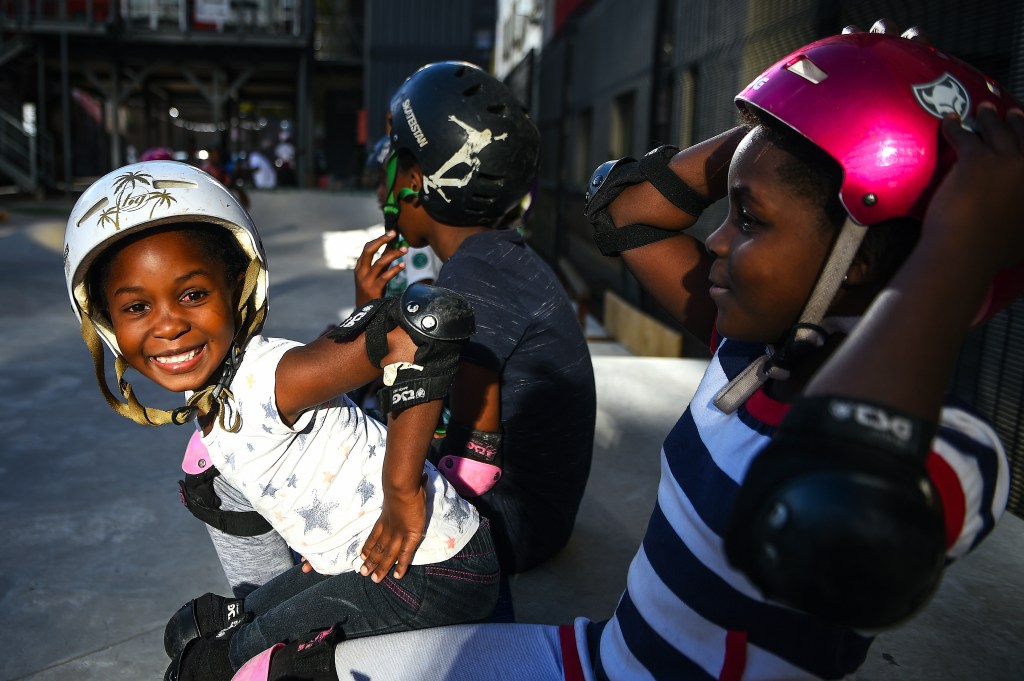
Picture © Andy Buchanan
And how many people are working with you?
We have 60 full time staff, and we’ve got a we’ve got a budget of $2.4 million
Now, you work from your office in Berlin, and what is your daily basis?
A lot of my job definitely involves fundraising. That’s a role that I play very outward, focused role to like, let as many people know about what we’re doing, and try to raise money for all of these projects that are around the world. And so I try to meet with people that hopefully can support the organization, so meeting with governments, meeting with foundations, meeting with companies, meeting with individuals. And then there is a bit of a coordinating role, working with the different boards. We have many different legal entities around the world to do the fundraising and to also run the projects. I need to coordinate with all of the different boards and just basically run a large very successful non profit organization.
Through all you in accomplish, what are you the most proud of?
I think I’m just absolutely in awe of what it just the fact that it exists, just the fact that it’s actually possible, and all of these things just seemed so unrealistic.
You actually started from nothing
Nothing, and also just It came from the the children, I didn’t want to start a nonprofit, they wanted to, they wanted to skateboard, and we simply invested in them. And so the fact that Skateistan exists, yes, is amazing, and I hope that it keeps on growing. I’m especially proud of kids that I met on the street in Kabul in 2007, some of them are running the programs for Iran and for Afghanistan. These are poor children working on the street as an 11 year old, and now they’re like, running things internationally. It’s amazing working on at such a high level, and we are winning awards for the work that we’re doing. And these kids are part of it. And another thing I’m really proud of is the the Good Push network.
Tell me about the Good Push
The Good Push came from lots of other social skateboard projects starting popping up. Some of them were very inspired and we wanted to see them succeed as much as possible. So we started to just open source everything that we had, everything that we knew, all of our knowledge, and we ran e-courses and webinars and put lots of resources on online.
You provide resource to make people success
And how can they not make all of the mistakes that I’ve made over.
And to finish, what would you like to achieve in the future?
I simply want to keep on seeing this grow. I really hope that Skateistan can have a presence in every single country in the world right now. If you look at the Good Push map, there’s a massive gap over China and over Russia. So it looks like the geopolitical world right now. Why is this? We need to have as many connections between every single human on the planet as possible. And don’t give a fuck about where somebody is living.
I guess there are places that it’s hard to go. I mean, you’re not going to North Korea.
I would love. I mean, I think we want to go to the the hardest places first, and then work backwards from there, because the hardest places we can have the greatest social impact. And this is what I’m looking for. We’ve got a we’ve we’ve got a certain overhead in a month, and I want to do the best I can with that money that we are spending, and it makes the most sense to work in the hardest to work places, because that money is then having the most impact. So we want to work in the hardest to work places first and then work backwards from there to cover the globe.
De passage au Connect Festival à Bordeaux, je passe devant le stand Skateistan, qui étaient présent pour promouvoir leur activités et aussi . Et pour être hônnete, je n’avais jamais beaucoup prêté attention aux différentes ONG qui oeuvrent pour developper des oeuvres caritatives et humanitaires grâce à la pratique du skateboard dans des lieux où l’on n’imaginerais même pas que le skate soit le moindre début d’une préoccupation, ou surtout qu’ils ne reporésentent pas des lieux et situation très marketable pour l’industrie.
C’est vrai qu’à travers leur projets, on est loin de la promotion d’une collab ephemere de marques chaussures/board avec les skaters les plus hype du moment qui skatent les spots de Paris pendant la fashion week.
Lorsque Oliver Percovich le fondateur de Skatesistan et son collègue Oisin Tammas m’ont alpagué pour me perler de leur activités, je fut lancé dans une longue discussion et un moment donné j’ai interrompu Oliver pour lui dire que j’avais envie de faire une interview, que nous avons fait le lendemain.
Commençons par te parler de toi et de ton parcours avant de créer Skateistan.
Je m’appelle Oliver Percovich. Je suis originaire de Melbourne, en Australie. J’ai eu un skateboard par mon cousin, qui skatait dans les années 70, et j’ai eu cette planche en 1980, et j’ai toujours skaté depuis. J’ai grandi en Papouasie-Nouvelle-Guinée, et j’y ai fait du skateboard, puis quand je suis revenu en Australie, j’ai fait beaucoup de différents métiers, mais mon identité de skateur était toujours là. Et je travaillais à l’université, dans la recherche. Je suis parti en Afghanistan à la recherche d’un emploi, probablement dans la recherche au départ.
Tu prenais tes études très au sérieux ?
Ouais, j’ai étudié la chimie en fait, puis j’ai travaillé dans une branche complètement différente en sciences sociales dans une université. J’ai eu une boulangerie. J’ai eu des entreprises. J’ai fait beaucoup de choses différentes. J’ai donc un esprit entrepreneurial, et le fait que les enfants voulaient skater et ne voulaient pas me rendre mon skateboard, je me suis dit, bon, je ne sais pas comment faire une association à but non lucratif ou une ONG, je ne sais pas comment aider ces enfants, vraiment. Et je me sentais assez impuissant. Mais je me suis dit que j’allais essayer.
Et juste en général, peux-tu nous dire ce qu’est l’ONG ?
Une ONG est juste une organisation à but non lucratif, au lieu d’essayer de vendre des choses et de gagner de l’argent pour toi-même, il s’agit simplement de créer un certain impact social positif. Et il y a beaucoup de secteurs caritatifs. Mais je ne suis pas toujours d’accord avec la façon dont les choses sont faites, car il y a parfois beaucoup d’argent dépensé avec très peu de résultats. C’est ce que j’ai vu quand je suis arrivé en Afghanistan, des budgets énormes. Ils n’avaient pas beaucoup de résultats, et ils ne travaillaient pas avec la démographie la plus importante, et c’était les jeunes. Les moins de 15 ans représentaient 70% de la population. Personne n’investissait donc, il me semblait simplement logique que lorsque les enfants de moins de 15 ans m’empruntaient mon skate, je me disais : “D’accord, faisons un projet avec eux.”
Dis-moi comment s’est passé le processus de création de Skateistan ?
Je n’avais aucune idée de comment créer une organisation, comment créer une entité juridique, mais j’avais déjà eu des entreprises où j’employais des gens. Et j’ai eu de l’aide de gens pour structurer cela et nous sommes simplement partis des statuts d’une autre ONG, et nous les avons en quelque sorte copiés et adaptés à notre projet et avons simplement commencé à bricoler comme ça. Si quelque chose fonctionnait, faites-en plus. Et c’était un énorme avantage que j’avais sur tous les autres projets, car beaucoup d’entre eux étaient basés sur du théorique et ils font tous la même chose, et ils font tous les mêmes erreurs, mais il est très difficile d’en sortir. Et parce j’avais beaucoup d’expériences dans des domaines très larges, je pouvais tirer différentes choses. Donc, quand nous avions besoin d’avoir de la nourriture pour les enfants, parce qu’ils venaient de familles pauvres, ils ne pouvaient pas se concentrer sur le skateboard ou en classe s’ils n’avaient pas mangé. J’avais l’habitude de gérer une entreprise alimentaire moi-même, donc je savais comment installer une cuisine. Quand nous devions récupérer les filles pour les faire entrer dans le programme de skateboard, nous avions besoin d’avoir des bus qui les ramèneraient et les amèneraient là-bas. Et j’étais livreur de pizza, donc je savais comment utiliser toute cette vaste expérience, mettre quelque chose en place qui avait un sens sur le terrain.
Au début, il s’agissait déjà du skateboard ?
Je ne suis pas allé en Afghanistan avec l’idée de lancer un projet de skateboard ou de créer une ONG. Je suis allé là-bas à la recherche d’un emploi, et j’étais un skateur, alors j’ai apporté un skateboard avec moi.
Tu t’es dit, rien n’est fait pour les enfants. Et je suis un skateur, donc je veux utiliser cet outil pour créer quelque chose pour eux ?
C’était ça. Je me sentais impuissant, je n’étais pas architecte, je n’étais pas ingénieur, je n’avais pas une profession qui pouvait réellement faire quelque chose d’utile, car je voyais toute cette misère autour de moi, et je ne savais pas quelle compétence je pouvais utiliser. Et puis je me suis rendu compte que, je suis un skateur, et ces enfants s’intéressent au skateboard, peut-être que je peux faire quelque chose de positif, et c’est devenu l’un des projets les plus réussis en Afghanistan à l’époque où nous avons commencé, lorsque le président afghan, Hamid Karzai, a fait un discours au Sénat américain, il a mentionné Skateistan dans son discours, et nous avons été vus dans l’un des endroits les plus en vue des nations occidentales où des milliards de dollars, étaient dépensés avec très peu de résultats.
Alors dis-moi comment tu as fait pour gagner de l’argent ?
J’ai parlé à différentes personnes à travers le monde. J’avais un ami qui avait un bar en Australie. Nous avons organisé une collecte de fonds là-bas. Quelqu’un d’autre savait comment créer un site Web pour nous, c’était un don. J’avais un peu d’argent au début, j’ai imprimé des T-shirts puis je l’ai ai vendu. J’étais très bricoleur, donc c’était juste quelques petites collectes de fonds, puis faire connaître aux gens ce que nous faisions, puis avoir un moyen de collecter quelques petits dons. Et puis à un certain moment, je frappais aux portes à Kaboul, essayant d’obtenir du soutien. Et en fait, le premier gros financement que nous avons obtenu provenait de l’ambassade du Canada à Kaboul, nous avons pu obtenir 15 000 dollars. Une fois que le gouvernement canadien a été impliqué, d’autres gouvernements étaient intéressés, car ils ne voulaient pas être les premiers à soutenir un projet risqué sur le skateboard. Et, tu sais, comme “Qu’est-ce que c’est ? Est-ce sérieux ? Est-ce qu’ils savent comment faire les choses, ou quoi que ce soit ?” Et je ne connaissais pas la langue, je n’avais pas le bagage. Tu sais, nous étions juste comme des punks sur un skateboard, pour faire quelque chose qui avait un sens. Mais l’important était que nous écoutions les enfants.
Mais as-tu ressenti de la peur face au contexte ?
Bien sûr. C’était un endroit effrayant pour vivre. Il y avait beaucoup d’attaques suicides tout le temps. Nous connaissions différentes façons de minimiser ces risques. Mais si tu fais des activités avec des filles en plein air dans la rue, n’importe qui aurait pu venir et avoir un problème avec ça. Il y a beaucoup de gens qui se promènent avec des armes à feu dans la ville de Kaboul, et n’importe quoi peut arriver à tout moment.
As-tu vécu une mauvaise situation ?
La fontaine où nous skations en 2008, il y a eu un attentat-suicide à environ 100 mètres. Ce n’était pas exactement au moment où nous étions là, et je suis resté à l’écart pendant un jour ou deux, puis je suis revenu à la fontaine, et tous les enfants me disent : “Pourquoi tu n’es pas venu hier et l’avant-veille ?” Et je dis : “Eh bien, il y a eu un attentat-suicide, j’ai peur”. Ils disent “Ça va, ne t’inquiètes pas” C’était leur quotidien.
Ce qui était très difficile, c’était d’être dans un endroit dangereux et de ne pas avoir d’argent, comme si je vivais avec 20 euros par semaine pour simplement survivre. J’avais des amis à Kaboul qui travaillaient pour l’ONU et d’autres agences, et ils avaient tous des salaires énormes, et ils m’ont invité à un anniversaire, mon anniversaire, et je ne pouvais même pas me payer un taxi afghan pour 2 $ pour me rendre à mon propre anniversaire, et j’ai dû l’emprunter à un ami. C’était dur. C’était vraiment deux mondes différents. Ils étaient dans le monde normal du développement international, et j’étais dans cette sorte de DIY du genre, “travaillons avec les enfants et trouvons comment le faire”.
Tu es allé en Afghanistan tout seul ?
J’ai d’abord suivi une petite amie à Kaboul, mais nous nous sommes séparés, et je suis resté en Afghanistan et j’ai continué à y travailler. J’ai loué une maison. Je sous louais des chambres à d’autres étrangers. C’était donc une source de revenus pour moi. J’ai rencontré le nouveau président du Comité olympique et je l’ai emmené à la fontaine où nous skations, et il voit tous les enfants skater, il est super intéressé. Il nous a mis à disposition un emplacement sur le terrain du Comité olympique. Et puis avec ce terrain, et avec des plans de skateparks créés pour nous d’Australie, et il y avait des entrepreneurs en Afghanistan qui construisaient différentes infrastructures, et j’ai essentiellement rassemblé toutes ces différentes personnes, de l’argent des ambassades, de l’argent d’Architecture for Humanity, Nike aussi à l’époque, et pour 200 000 $, nous avons construit ce qui était normalement fait pour 800 000 $ à Kaboul. Donc tous les donateurs étaient époustouflés. Nous pouvions faire tellement avec si peu parce que l’entreprise de construction a construit à 150 000 sous le prix de revient, cela leur a coûté 350 000 $ pour construire le bâtiment, mais ils ne nous facturent que 200 000 $ d’accord. Et puis j’avais trois ou quatre donateurs différents, l’ambassade d’Allemagne, l’ambassade du Danemark, l’ambassade de Norvège, étaient tous des donateurs pour le construire. Et pour eux, c’était comme de minuscules sommes d’argent. C’est devenu ainsi le plus grand centre de sport et d’éducation en salle pour enfants.
Quelle a été la prochaine étape après ce projet à Kaboul ?
De là, nous avons construit une installation dans le nord de l’Afghanistan, à Mazâr-e-Sharîf, qui était trois fois plus grande que celle de Kaboul. Kaboul avait une capacité de 500 enfants par semaine, à Mazâr-e-Sharîf, nous avions une capacité de 1500 par semaine. Nous avions la moitié de filles et la moitié de garçons tout au long des programmes, 750 filles venaient skater au même endroit chaque semaine. Et il n’y a nulle part ailleurs dans le monde où il y avait 750 filles qui faisaient du skateboard au même endroit.
Les installations sont-elles toujours là de nos jours ?
Les skateparks intérieurs que nous avons construits à Kaboul et à Mazâr-e-Sharîf ont tous deux été repris par les talibans. Ils ont les rampes là-dedans et tout ça, nous n’avons pas accès. Ils ont essayé de nous louer à nouveau, comme 10 000 par mois, et nous avons refusé, comme nous l’avons construit en premier lieu. Mais nous avons toujours cette infrastructure que nous avons construite à Daman dans le centre de l’Afghanistan, nous pouvons toujours y opérer. Et il y a un skatepark en béton. donc nous sommes capables de continuer à faire du skateboard. Et puis beaucoup d’enfants qui faisaient partie de notre programme à Kaboul et à Mazâr, sont allés partout dans le monde, s’ils parviennent à quitter le pays, puis ils font du skate à Bruxelles ou à New York ou dans différents endroits. Mais maintenant nous avons aussi des écoles de skate au Cambodge et en Afrique du Sud, et nous avons des projets partenaires dans 21 lieux. Nous sommes donc en Iran, en Irak, au Liban, en Jordanie, au Kenya, au Soudan du Sud, etc.
Et combien de personnes travaillent avec toi ?
Nous avons 60 employés à plein temps, et nous avons un budget de 2,4 millions de dollars.
Maintenant, tu travailles depuis ton bureau à Berlin, et quelle est ta routine quotidienne ?
Une grande partie de mon travail implique la collecte de fonds. Je joue un rôle aussi très important c’est faire connaître à autant de gens que possible ce que nous faisons, et essayer de collecter des fonds pour tous ces projets qui sont dans le monde entier. Et donc j’essaie de rencontrer des gens qui peuvent, espérons-le, soutenir l’organisation, donc rencontrer des gouvernements, rencontrer des fondations, rencontrer des entreprises, rencontrer des individus, puis il y a un peu de coordination, travailler avec de nombreuses entités juridiques différentes dans le monde pour faire la collecte de fonds et également gérer les projets. Nous avons beaucoup d’entités juridiques, et chacune de ces entités juridiques a un conseil d’administration, donc je dois me coordonner avec tous les différents conseils d’administration.
A travers tout ce que tu as accompli, de quoi es-tu le plus fier ?
Je suis simplement émerveillé par le fait simplement que cela existe, juste le fait que ce soit réellement possible, et tout semblait si irréaliste. C’est venu des enfants, je ne voulais pas commencer une organisation à but non lucratif. Ils voulaient faire du skateboard, et nous avons simplement investi en eux. Et donc le fait que Skateistan existe, oui, c’est incroyable, et j’espère que ça va continuer de grandir. Je suis fier des enfants que j’ai rencontrés dans la rue à Kaboul en 2007. Parce que certain d’entre eux ont commencé à travailler avec moi. C’était des enfants pauvres qui travaillaient dans la rue en et maintenant ils dirigent des choses au niveau international. C’est incroyable de travailler sur à un si haut niveau, et nous remportons des prix pour le travail que nous faisons. Et ces enfants font partie de tout ça. Et une autre chose dont je suis vraiment fier, c’est le réseau The Good Push.
Oui, parle-moi de The Good Push
Comme beaucoup d’autres projets de skateboard sociaux ont commencé à apparaître. Certains d’entre eux ont été très inspirés par Skateistan, et ont pensé que c’était cool, et voulaient faire quelque chose de similaire. Et nous voulions les voir réussir le plus possible. Nous avons donc commencé à simplement open-sourcer tout ce que nous avions, tout ce que nous savions, toutes nos connaissances, et nous avons mis des cours en ligne et des webinaires et mis d’autres nombreuses ressources en ligne.
Et pour finir, qu’aimerais-tu accomplir dans le futur ?
Je veux simplement continuer à voir cela grandir. J’espère vraiment que le stand de skateur puisse avoir une présence dans tous les pays du monde en ce moment. Avec le si tu regardes la bonne carte de poussée, il y a un énorme écart sur la Chine et sur la Russie. Donc ça ressemble au monde géopolitique en ce moment. Pourquoi est-ce? Nous devons avoir autant de connexions entre chaque être humain sur la planète que possible. Et ne t’en soucie pas où quelqu’un vit ou quoi,
Je suppose, quels pays où il est difficile d’aller. Je veux dire, tu n’iras pas en Corée du Nord ?
Mais j’adorerais ça. Je pense que nous voulons aller d’abord dans les endroits les plus difficiles, puis travailler à partir de là, car les endroits les plus difficiles peuvent avoir le plus grand impact social. Et c’est ce que je recherche. Nous avons un nous avons un certain surcoût par mois, et je veux faire de mon mieux avec cet argent que nous dépensons, et cela a le plus de sens de travailler dans les endroits les plus difficiles à travailler, car cet argent a alors le plus grand impact.


